Proposal resources
RFP Compliance Matrix: What to Check Before Writing
Turn the solicitation into a response plan. Record what the buyer requires, where each answer belongs, who will provide the evidence, and what still needs a decision.
An RFP compliance matrix connects each solicitation requirement to an action, a responsible person, and a place in the proposal. It gives the team a shared record to use from the first review through submission.
Build it before drafting. A polished answer can still miss a required attachment, rely on unsupported information, or appear in the wrong volume. The matrix makes these gaps visible while there is time to resolve them.
This guide describes a practical working method. The specific solicitation, its amendments, and the applicable procurement rules govern each opportunity. The U.S. federal references below are examples, not rules for every buyer or country.
1. Start with a complete source inventory
Collect the main solicitation, statement of work, specifications, attachments, pricing schedules, required forms, submission instructions, evaluation criteria, amendments, and any officially issued questions and answers. Check which documents are incorporated by reference.
Record each document’s title, version or issue date, and official source. Keep superseded files clearly marked. Record the clarification deadline and submission deadline with their time zones, along with the permitted submission method.
Read preparation instructions alongside evaluation criteria. For U.S. federal solicitations using the uniform contract format, Section L addresses response instructions and Section M identifies evaluation factors and their relative importance. Section K covers representations and certifications. Other solicitations may arrange this information differently. See FAR 15.204-5: representations and instructions.
Before assigning writing, flag eligibility conditions, unavailable evidence, and commitments the organization may be unable to meet. These need an early bid decision or clarification.
2. Use fields that lead to an action
A spreadsheet is enough. Create a separate row for each requirement that can be checked independently. Split a paragraph into several rows when it asks for several distinct items.
- Requirement ID
- Give each row a stable reference, such as R-001.
- Source
- Record the document version, section, page, and attachment reference.
- Requirement
- Describe the requested action accurately. Preserve conditions, limits, and exceptions.
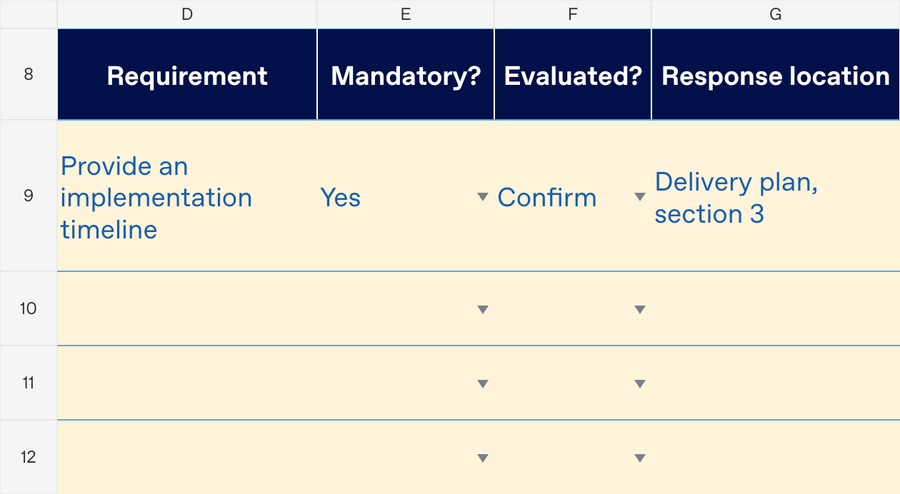
- Mandatory or evaluated
- Mark mandatory, scored or weighted, both, or unconfirmed. Record any stated weighting. Do not invent one.
- Response and evidence
- Identify the proposal section or file and the evidence needed to support it.
- Owner
- Name the person accountable for the answer or supporting material.
- Deadline
- Set an internal due date that leaves time for review and approval.
- Status
- Use clear states: open, drafting, clarification needed, ready for review, or verified.
A scored answer can also be mandatory. Keep both attributes visible. Where the solicitation gives no numerical weight, record its stated relative importance without converting it into a percentage.
3. Test the matrix with a small worked example
Fictional example: The three rows below describe an invented training-services procurement. They are not a client case, a real solicitation, or standard procurement requirements. T means the fictional submission deadline; these internal deadlines are illustrative.
| ID and source | Requirement | Type | Response and evidence | Owner | Internal deadline | Status |
|---|---|---|---|---|---|---|
| R-001 Instructions v1, §2.1 |
Submit a signed supplier declaration | Mandatory | Administrative file; completed form and authorized signature | Operations lead | T minus 3 working days | Open: signatory confirmation needed |
| R-002 Evaluation v1, §4.2 |
Explain the training delivery method | Required answer; weighted 30% in this fictional example | Technical §2; delivery schedule, trainer roles, and learning assessment method | Technical lead | T minus 5 working days | Drafting |
| R-003 Pricing schedule v1, note 3 |
Price every listed workshop and identify tax treatment | Mandatory | Pricing file; completed schedule reconciled to delivery assumptions | Finance lead | T minus 4 working days | Clarification needed: travel treatment |
Reviewers should be able to follow each row back to its source and forward to the exact response. A tick alone does not show that the evidence answers the requirement.
4. Control amendments and unresolved questions
Assign someone to monitor the official procurement channel. When a new amendment appears, log it, compare it with the previous version, and update every affected row. Check deadlines, pricing, forms, and page limits as well as technical requirements. Tell owners what changed and reopen completed rows where necessary.
In the U.S. federal context, FAR 15.206 addresses amendments when government requirements or terms change. An amendment can also change the closing date. See FAR 15.206: amending the solicitation.
If documents conflict, check any stated order of precedence. Use only the clarification channel authorized by the solicitation, before its question deadline. Record the question and official answer. Do not silently choose the easier interpretation or treat an informal conversation as permission to depart from a requirement.
5. Verify the response, pricing, and approval
Review the actual submission files against the matrix. Check that project descriptions, personnel details, delivery capacity, and other factual claims are supported and current. Reconcile staffing, quantities, schedules, assumptions, and totals across the technical response and pricing schedule.
Have the responsible organization confirm declarations and certifications. Obtain approval from its authorized decision-maker for the final proposal, price, and commitments. A proposal writer should not assume authority to sign or make declarations for the bidder.
Plan time to validate files and complete the required submission steps. For U.S. federal proposals covered by FAR 15.208, the offeror is responsible for timely delivery to the designated office using an authorized method. See FAR 15.208: proposal submission. Follow the actual solicitation’s instructions and retain the available submission confirmation.
Final 10-point RFP compliance checklist
- Confirm the complete, current solicitation package and amendments.
- Check eligibility and unresolved bid-decision issues.
- Map every response requirement to its source.
- Separate mandatory conditions from scored criteria, recording overlaps.
- Assign an owner, evidence, and internal deadline to each row.
- Resolve ambiguities through the authorized clarification channel.
- Verify factual claims, attachments, and declarations.
- Reconcile pricing with scope, staffing, and delivery assumptions.
- Obtain authorized approval of the final files and commitments.
- Check format, destination, deadline, and receipt requirements.
Use the ComplianceMatrix sheet in the Proposal Planning Templates workbook to put this checklist into practice. Replace the fictional examples and adapt every requirement to the current solicitation.